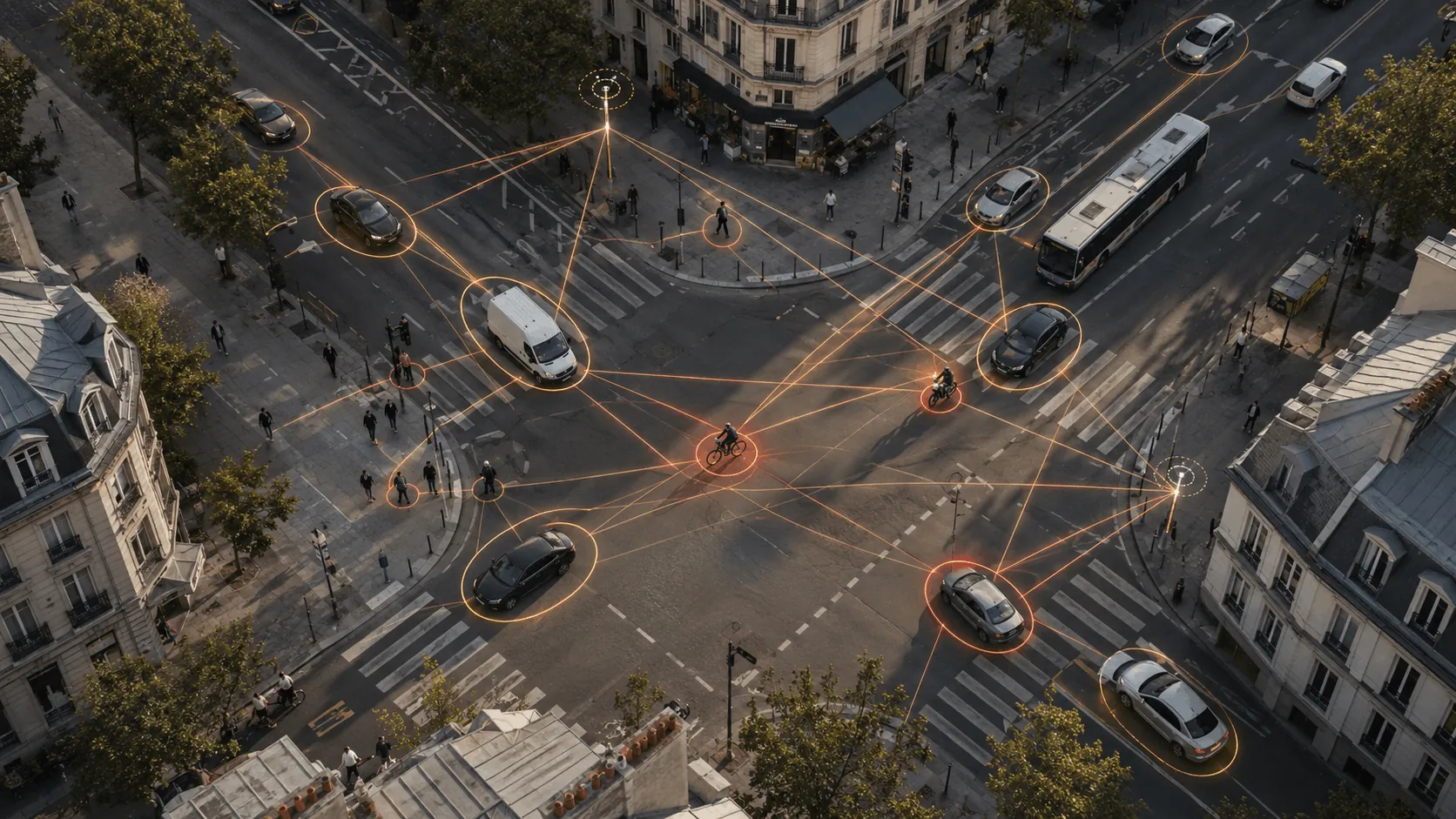
Connected vehicles, cyclists, and roadside infrastructure sharing V2X safety information on an urban corridor

ABOUT V2X

How vehicle-to-everything communication helps road users see what line of sight alone cannot.

The Fundamentals

What Is V2X

V2X, or Vehicle-to-Everything, is a connected system that allows motorized vehicles, bicycles, roadside infrastructure, and digital road infrastructure to share information. It combines direct communication and network communication into one hybrid approach, depending on the use case and how quickly the information needs to travel.

V2X is a global family of interoperable technologies that shares trusted, standardized messages about position, motion, signal status, road hazards, and vulnerable road users. While technical frameworks differ between regions, the goal is the same: improving awareness and coordination for all road users.

By extending awareness beyond line of sight, V2X helps road users detect what is happening earlier, coordinate better, and respond more smoothly. This can make interactions on the road feel more predictable, connected, and reassuring across the whole journey.
Two Communication Paths

Direct communication

Nearby · short-range

Direct communication connects nearby road users and infrastructure directly, making it possible to share information within the immediate traffic environment. It is especially useful for use cases that benefit from short-range exchange and interactions without relying on the mobile network.

Network communication

Broad · cellular

Network communication connects road users and infrastructure through the mobile network and digital services, enabling information to be shared over a broader area and integrated with backend systems and digital road infrastructure. It is especially useful when information needs to be distributed beyond the local surroundings or connected with wider mobility services.

Together, both communication paths make V2X flexible and scalable. A key part of this hybrid approach is that information does not only flow one way: data can move from road users and infrastructure to digital services and back again, supporting both immediate local interactions and broader connected services.
The Technical Framework

How V2X Works

V2X works by exchanging structured messages between road users and infrastructure. These messages can travel through two complementary communication paths: direct communication for nearby interactions and network communication for broader, mobile-network-based connectivity. Which path is used depends on the use case and the required responsiveness.

V2X is built on standardized message families that differ by region but serve similar purposes. In general, these messages help road users and infrastructure share information about position, movement, signal status, road conditions, and relevant events in the surrounding environment. The result is a more connected view of what is happening on the road, beyond what can be seen with cameras, radar, or human sight alone.

Europe: ETSI ITS / C-ITS

In Europe, V2X deployments are commonly associated with ETSI ITS and C-ITS standards. These systems support a range of message types that help vehicles, bicycles, and infrastructure exchange information efficiently and consistently.

  • CAM (Cooperative Awareness Message): shares dynamic status such as position, speed, and heading.
  • DENM (Decentralized Environmental Notification Message): communicates event-based hazards and temporary road situations.
  • SPAT and MAP: support signal timing and intersection geometry.

United States: SAE J2735

In the United States, V2X deployments commonly use SAE J2735 message sets. These message families serve similar functional roles, even though the terminology differs from Europe.

  • BSM (Basic Safety Message): provides periodic vehicle awareness.
  • SPaT (Signal Phase and Timing): shares signal phase and timing information.
  • MAP: describes intersection geometry.
  • TIM (Traveler Information Message): provides traveler-related information.
  • PSM (Personal Safety Message): supports use cases involving vulnerable road users such as pedestrians and cyclists.
Spectrum and range

Across both regions, V2X can be implemented through either short-range direct communication or long-range network communication. Short-range communication enables low-latency exchange over the ITS band in the 5.9 GHz licence-free spectrum and is widely available, unlike mobile network coverage, which depends on the cellular infrastructure in a given area. Long-range communication uses cellular networks and backend connectivity to extend reach, aggregate data, and support broader services. Together, these two modes provide the foundation for timely, reliable, and context-aware communication between road users and infrastructure.

Relevant Use Cases

From Awareness to Ecosystems at Scale

Day 1

Awareness and Warning

Day 1 services focus on making road users digitally visible to one another and delivering basic warnings.

Typical use cases include vehicle-to-bike awareness, cyclist presence warnings, road hazard alerts, roadworks information, basic intersection awareness, and signal phase information. In Europe these services are often associated with CAM, DENM, SPAT, and MAP, while in the United States similar functions are supported through BSM, SPaT, MAP, TIM, and related safety messages.

Day 2

Cooperative Assistance

Day 2 services go beyond simple awareness by supporting predictive warnings and more coordinated behavior.

Typical use cases include cooperative intersection assistance, trajectory-based collision prediction, infrastructure-assisted crossing support, and richer interactions between vehicles and vulnerable road users. These services require broader deployment, stronger interoperability, and more mature implementation across vehicles, infrastructure, and devices.

Day 3

Cooperative Ecosystems at Scale

Day 3 services represent a more advanced and integrated V2X environment.

This includes highly coordinated safety systems, deeper infrastructure integration, advanced support for automated driving functions, and large-scale traffic management that includes cyclists and other vulnerable road users as active participants in the connected safety ecosystem.

The Path to Scale

How to Scale V2X

V2X reaches its full safety potential only when a critical mass of vehicles, infrastructure, and road users is connected. That creates a clear adoption challenge: the first customer pays before the full safety benefit is visible, while the last customer receives the largest gain.

BENEFITS DEPLOYMENT RATE / TIME high low POINT OF SALE INFRASTRUCTURE INSTALLATIONS EARLY USER BENEFITS DRIVING DEPLOYMENT SAFETY BENEFITS
  • Infrastructure installations
  • Early user benefits driving deployment
  • Safety benefits

To scale V2X, the value proposition must work on two levels at the same time. Early deployments need to deliver immediate, tangible benefits to the paying customer, while the broader system is designed so that safety benefits increase as deployment grows.

Infrastructure installations play a central role in bridging this gap. Roadside units, signal integration, and corridor-based deployments can create early value through better signal timing information, intersection awareness, priority handling, and added support at busy or complex locations. These use cases give municipalities, fleets, and infrastructure operators a reason to invest before full market penetration is reached.

The scaling strategy connects three things:

  1. Point-of-sale value for the first customer.
  2. Early user benefits that drive deployment.
  3. Safety benefits at scale that grow with coverage.

In this model, infrastructure is not just a technical enabler. It is also a way to create the first proof of value, build trust, and accelerate the transition from pilot projects to real-world deployment.

Deployment in Practice

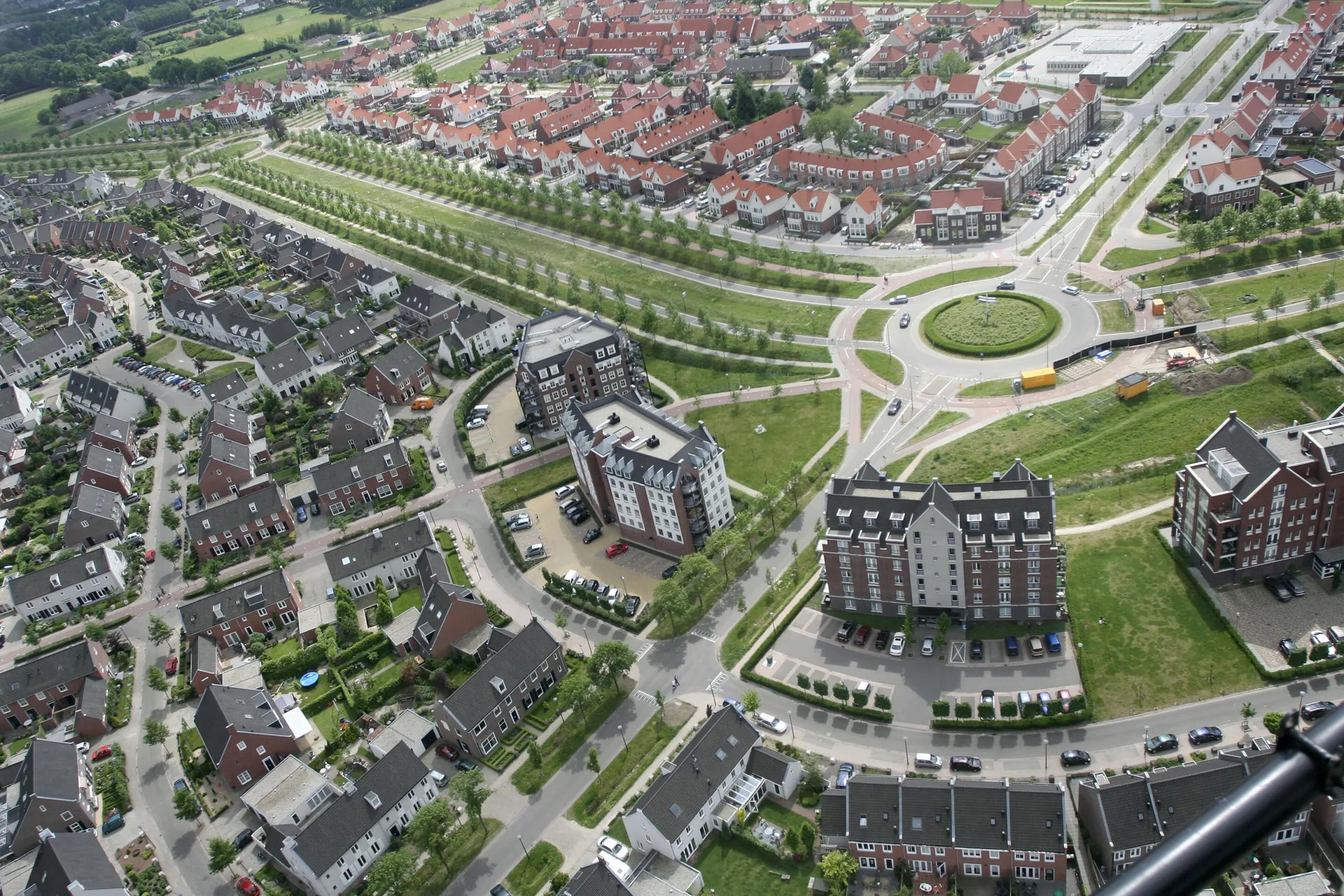
V2Xperience in Helmond

A strong example is V2Xperience in Helmond. It shows how infrastructure-led deployment can make V2X tangible in practice, create early user benefits, and demonstrate how local installations can support the path toward broader safety at scale.

V2Xperience deployment in Helmond with connected roadside infrastructure
Join the Coalition

Be Part of the
Coalition Today

The Coalition for Cyclist Safety brings together leading experts across sectors. Cross-sector collaboration is not optional, it is the only path to getting V2X technology deployed at scale. Your organization's expertise is needed to make safer roads a reality.

Membership

YOUR VOICE SHAPES V2X

  • Access to cutting-edge V2X technology and deployment frameworks developed across the Coalition's working groups.
  • Direct collaboration with leaders from automotive, cycling, telecom, and technology sectors working toward shared road safety goals.
  • Strengthen your organization's leadership position in road safety by aligning with the Coalition driving real-world V2X deployment.
Join the Coalition